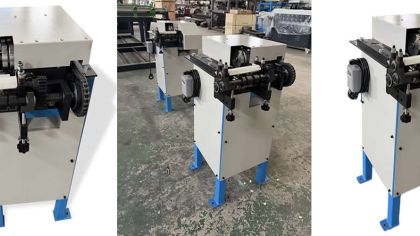
Machines for the production of rectangular air ducts
Air ducts are the foundation of any ventilation system. Therefore, their quality should never be overlooked.
Today, we will review the technology used to manufacture rectangular air ducts, which are widely applied in industrial, warehouse, and commercial facilities.
Production Process Sequence

The manufacturing of rectangular air ducts involves 7 stages:
-
Bending the steel and forming the HVAC.
-
Adding reinforcement ribs.
-
Creating the seam joint.
-
Pressing (closing) the seam joint.
-
Producing the frame (flange profile).
-
Connecting the frame to the HVAC.
Each of these steps has its own specific features and requires different equipment.
How to Automate the Process?
If you aim to automate air duct production, you will need to implement an automatic line and a tunnel assembly machine. This combination enables high productivity and efficiency in manufacturing.
Automatic Lines for Cutting, Profiling, and Bending Steel Sheets
A single automated line can perform several key tasks within the production cycle: cutting, profiling, and bending steel sheets. Typically, large-scale manufacturers use CNC-controlled automated lines. This ensures high precision in HVAC production, minimizes material waste, reduces costs, and improves overall product quality.
Tunnel Assembly Machine
These machines are designed for automatic seam forming and pressing.
The tunnel assembly machine performs three essential steps:
-
Seam forming,
-
Joining,
-
Seam pressing.
A seam created using a tunnel assembly machine provides exceptional strength, often considered an additional form of reinforcement.
Following this stage, the installation and fastening of flanges can proceed.
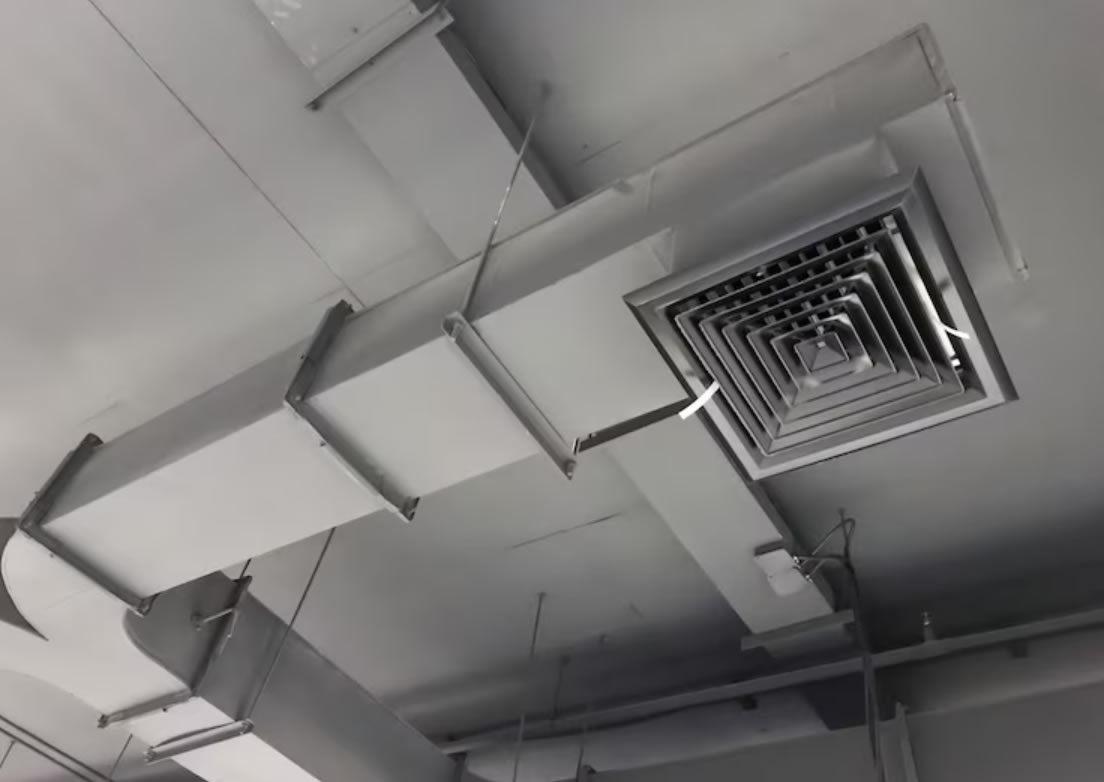
Replacing Automated Lines
In the absence of an automated line for rectangular HVAC production, manual or electromechanical machines are used. This results in a longer production line, which includes:
-
Guillotine shear,
-
Sheet bending machine,
-
Equipment for adding reinforcement ribs,
-
Seam-pressing machine.
Guillotine Shears for Steel Cutting
Both manual and electromechanical guillotine shears are suitable for industrial applications.
Equipment with a length of 2.5 meters is commonly used, as it is optimal for longitudinal cutting of standardized steel sheets.
For shaped components, swing-beam guillotine shears can also be used as a more cost-effective solution.
Sheet Bending Machine for Forming the HVAC
The HVAC is formed using a sheet bending machine, which can also be manual or electromechanical.
Models with a standard working length of 2.5 meters are typically sufficient.
It is important to consider the machine’s capacity. Preferably, it should be capable of bending steel sheets with a thickness of 1.2 mm or more.
Machines for Adding Reinforcement Ribs
Reinforcement ribs increase the durability of HVAC components. While small-section systems may not require them, large-section HVAC units must include reinforcement ribs.
Special machines allow ribs to be applied across the entire steel sheet surface.
By using profiling machines for ribbing, HVAC components can be made from thinner steel sheets, reducing the overall cost of the ventilation system.
Seam-Rolling Machines for Forming Seam Joints
On straight and shaped HVAC sections, seam joints are formed using seam-rolling machines equipped with specific rollers.
For mass production of rectangular HVAC systems with straight sections and steel thickness between 0.7–1.25 mm, seam-rolling machines with snap-lock rollers are highly efficient.
HVAC units with snap-lock seams can even be assembled directly on-site. Since transporting pre-cut blanks is easier and cheaper than shipping full-size HVAC systems, overall costs are reduced with this method.
For straight sections, the Pittsburgh seam is formed using a seam-rolling machine equipped with the appropriate rollers.
On shaped sections, seam joints are created with an edge-bending machine, which bends the edge of a curved blank at a 90-degree angle to form the counterpart of the corner seam.
Clamping the Corner Seam on Shaped Parts Before Rolling
To secure the corner seam on a shaped blank, a steel sheet is inserted into the Pittsburgh lock before proceeding to rolling.
Rolling on a Segmental Rolling Machine – Without Clamping the Corner Seam
An alternative to preserving the corner seam is to use a segmental rolling machine. This type of equipment allows the roller width to be adjusted so that the lock is not compressed during the rolling process.
Seam-Pressing Tool for Closing Seam Joints
The corner seam is closed using a seam-pressing tool. Additionally, pneumatic hammers are recommended to ease the work of sheet metal workers.
Equipment for Producing the Frame Profile
Rectangular HVAC systems and shaped parts are connected using flanges, which consist of four metal angles and the frame profile.

Duct Cutting Saws
Specialized duct saws or swing saws for metal cutting are used for cutting the frame profile. These provide clean, burr-free cuts.
Clinching Tool for Attaching the Frame to the HVAC
A manual clinching tool is the simplest and most affordable solution for flange installation. It is suitable both for HVAC manufacturing and assembly.
Equipment for Producing Shaped Parts
Additional equipment is required to cut, process, and assemble shaped parts.
For cutting, the following can be used:
-
Handheld electric shears for small workshops (requires pre-marking of cutting lines),
-
Plasma cutting tables for large-scale production (laser cutting tables are also an option).
For bending and giving shaped parts their non-standard form (such as adapters, rectangular end caps, etc.), segmental bending machines are used.
Spot welding machines are often utilized for assembling shaped parts, offering an optimal solution for working with thin steel sheets.
If you want to set up rectangular HVAC production with maximum efficiency and quality, contact the experts at Stan Roll Forming Machines Inc. We will help you choose the right equipment, provide support at every stage of implementation, and offer comprehensive solutions to make your business more competitive. Get in touch with us today for a consultation or project estimate!