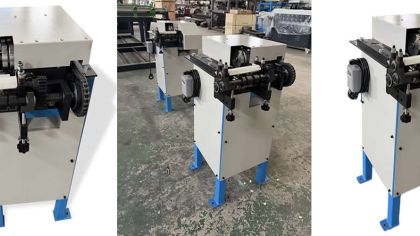
Spiral Duct Machines: Description and Operating Principle
The use of modern technological equipment makes it possible to increase production volumes and improve the quality of finished products. Today we will look at machines for manufacturing spiral ducts of various diameters, widely used in construction for building air conditioning and ventilation systems.
Industrial Spiral Duct Manufacturing Technology
This production method involves creating lock seams along the longitudinal edge of the strip using forming rollers. The workpiece is then bent along spiral guides into a cylinder, after which the seams are locked and the workpiece is cut to size.

The process includes the following steps:
-
Loading a coil of strip onto a decoiler (uncoiler).
-
Feeding the strip into the lock-forming unit.
-
Straightening the strip and rolling the edges to create lock seams and stiffening ribs.
-
Bending the workpiece along guide rings of the specified diameter, spiraling it with subsequent joining and locking of seams to form a strong, airtight joint.
-
Cutting the finished spiral duct with a milling cutter or circular knife into required lengths, producing a straight or beveled edge that requires no further processing.
The spiral duct manufacturing line is automated and controlled by a programmable system. Equipment productivity depends on the model and configuration but is at least 20,000 linear meters of product per month.
Design of the Spiral Duct Machine
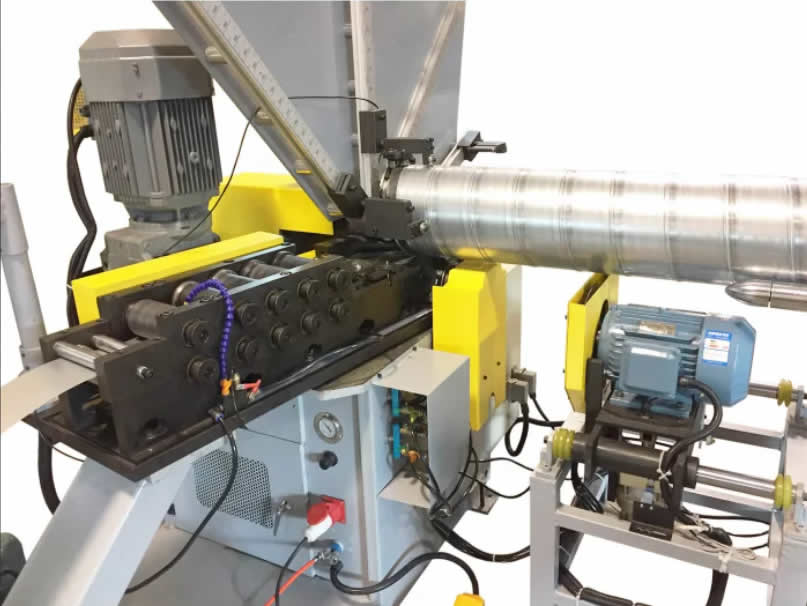
This type of production line ensures a complete technological cycle, from raw material processing to finished product output. The main components of the machine include:
-
strip decoiler;
-
lock seam forming unit;
-
bending and spiraling unit for wrapping the strip onto rings;
-
cutting device with circular knives or a milling cutter.
Strip Decoiler: Design and Operation

Metal strip decoilers come in two types:
-
passive – mounted on wheeled trolleys for easy movement around the production area;
-
servo-driven – provide automatic positioning and precise material feeding.
This design allows the decoiler to be adjusted for manufacturing ducts of various diameters and winding angles. The rotary rolling section enables changing the feed direction of the metal strip.
Lock Seam Forming Unit
Lock seams along the strip edges are formed by paired rollers (ranging from two to six in the rolling unit). Increasing the number of rollers improves accuracy, ensuring consistent seam geometry even at high speeds (up to 40 m/min).
Types of Bending Units: Flexible and Rigid Rings
-
Flexible rings – allow quick reconfiguration of the equipment for different product diameters but may permit geometric deviations.
-
Rigid rings – manufactured according to reference templates, reducing tolerances to hundredths of a millimeter.
The choice of forming unit depends on production volume, final product requirements, and product range.
Methods of Cutting Spiral Ducts

Cutting is performed using:
-
circular knives – low noise level, no edge overheating, no need for consumables, but require precise adjustment;
-
milling cutters – standard option in basic machine configurations.
The use of modern automated machines for spiral duct manufacturing significantly increases production efficiency. These technological lines deliver a wide range of high-quality products that meet the current requirements of the construction industry.