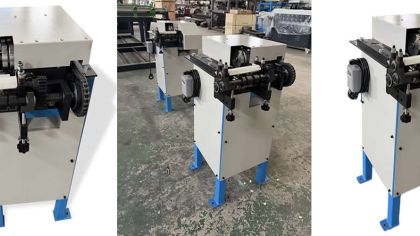
Profile Bending Machines: Types, Purpose, and Applications
Profile bending machines, or profile benders, are essential equipment in metalworking and construction. They ensure precise and high-quality bending of various metal profiles.
Operating Principle
Profile benders operate based on mechanical or hydraulic force applied to the metal, allowing it to be reshaped without damage. The main principle is transferring force to the bending tool, which interacts with the workpiece and gradually changes its shape.
The bending process requires precision and care to prevent material defects. Depending on the machine’s design, bending can be performed in one or multiple stages, enabling the creation of complex profiles.
Modern technologies, including Computer Numerical Control (CNC), significantly enhance accuracy and efficiency, minimizing human error.
Types of Profile Benders
There are several main types of profile bending machines, each with its own features and applications:
-
Manual Profile Benders – the simplest devices powered by the operator’s physical effort. Ideal for small-scale production and light profiles. Commonly used in small workshops and custom projects.
-
Electric Profile Benders – equipped with electric motors, simplifying and speeding up the bending process. Suitable for high-demand production environments. Often feature automatic material feeding and pre-set bending angles.
-
Hydraulic Profile Benders – use a hydraulic system to generate significant force, enabling work with thick and rigid materials. Widely applied in construction and heavy engineering, providing high performance and durability.
-
CNC Profile Benders – modern automated machines allowing programmable bending processes, delivering maximum precision and speed. Perfect for mass production and complex profiles. Capable of performing multiple operations in one cycle, saving time and reducing error risks.

How to Work with a Profile Bender
Operating a profile bender requires proper knowledge and skills:
-
Material Preparation – inspect the workpiece for correct dimensions and absence of defects.
-
Machine Setup – adjust the required bending radius and angle according to the technical specifications. Review the machine manual.
-
Bending Process – feed the material smoothly, ensuring uniform deformation control.
-
Result Verification – evaluate the finished product for compliance with the specified parameters.
How to Choose a Profile Bender
When choosing a profile bender, consider the following:
-
Work Volume – for large-scale operations, hydraulic or electric models are optimal.
-
Material Type – ensure the machine is compatible with the metals you plan to process and verify thickness limits.
-
Budget – consider not only the purchase cost but also maintenance and spare parts expenses.
-
Precision Requirements – for high-precision work, opt for CNC models.
Conclusion
Profile benders are essential tools in metalworking. Properly selected and configured equipment boosts productivity, improves product quality, and reduces manufacturing costs. Regular maintenance and skill development in working with profile benders ensure steady growth for your metalworking business.