The Principle of Rotational Metal Spinning
Fundamentals of Rotational Metal Spinning
Rotational metal spinning is a sheet metal forming method used to produce hollow parts of various shapes without chip removal.
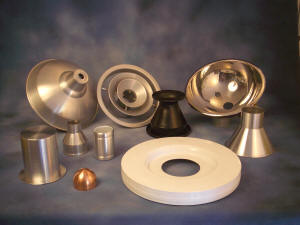
In this metalworking process, a round metal blank, tube, or semi-finished product is first set into rotational motion. Forming rollers apply pressure to the rotating metal workpiece, causing the metal to flow and take the shape of the mandrel. This method enables the production of complex parts with precise geometry, tight tolerances, and excellent surface quality while minimizing tooling costs. The main advantage of the rotational metal spinning process is achieving maximum accuracy in replicating the contour of the part.
The Global Use of Rotational Metal Spinning
Today, rotational metal spinning technology has become less common in CIS countries. However, in China and the United States, many manufacturers continue to use this technique, both at high-tech production
facilities and small workshops relying on manual labor. Advanced CNC metal spinning lathes are widely applied across light and heavy industries for manufacturing components for military equipment, spacecraft, aircraft, automobiles, and more. These industries require not only precise geometric dimensions but also specific density, internal stress distribution, and other physical characteristics in finished products. To optimize these processes and ensure correct programming of equipment, engineers use various mathematical models, such as computer simulation of metal spinning.
Types of Metal Spinning Equipment
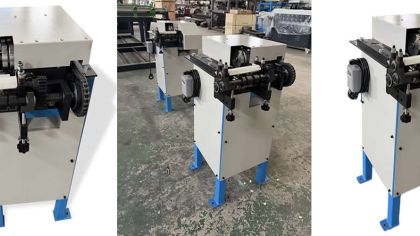
For such advanced applications, CNC metal spinning lathes are utilized.
For simpler components, manual metal spinning lathes or hydraulic-assisted metal spinning machines can be used. In these cases, the operator controls the forming tool via a joystick, reducing physical effort in deforming the workpiece. Many of these machines feature a memory system that records the operator's actions for subsequent batch production in automatic mode.
Rotational Metal Spinning on Manual Lathes
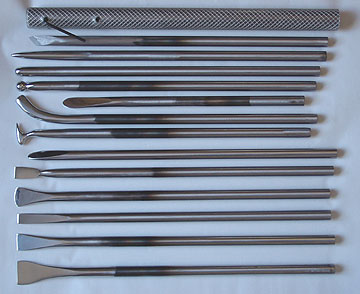
The primary tool for manual metal spinning is a hardened metal rod (30-40mm in diameter) with a polished forming head at the end. Commonly used head shapes include “duckbill” and “sheep nose.” For working with ferrous metals or stainless steel, it is best to use hardened steel rollers (such as those made from R6M5 tool steel, hardened to 60 HRC). For softer metals like aluminum, fluoropolymer rollers or similar materials help limit pressure and prevent excessive thinning or tearing of the workpiece. The images below illustrate various tool head types:
Key Applications of Rotational Metal Spinning
-
Lighting fixtures manufacturing in Canada
-
Metal forming for aerospace industries in Canada
-
Production of household goods
-
Applied arts and decorative metalwork
-
Chemical industry applications
-
Tank manufacturing and space industry
-
Musical instrument manufacturing
-
Aviation components production
-
Antenna manufacturing and telecommunications sector
-
Food industry equipment production
-
Automotive parts manufacturing in Canada
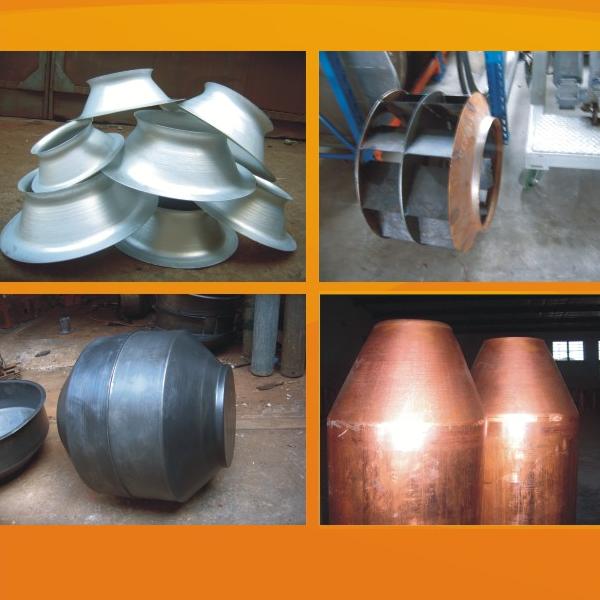
By integrating rotational metal forming technology, Canadian manufacturers can achieve higher precision and efficiency while maintaining cost-effective production. This method remains a valuable technique in various industries, ensuring durable and high-quality metal components.
rotational metal spinning Canada, CNC metal spinning lathe Canada, manual metal spinning Canada, metal forming process Canada, aerospace metal components Canada, automotive metal parts Canada, industrial metal spinning Canada, precision metal forming Canada, sheet metal spinning Canada, custom metal fabrication Canada